Traditional Paintings of Sri Lanka: A Cultural Guide for Visitors
Sri Lanka has one of the longest unbroken traditions of mural painting in Asia. From prehistoric cave markings to 5th century frescoes and 18th century temple murals, the island's painting heritage spans more than two thousand years. Each period has its own style, technique, and subject matter, and examples of every major tradition are still visible today at sites across the country.
This guide covers the four main periods of Sri Lankan traditional painting, the techniques and materials behind them, and where visitors can see the finest surviving examples.
Four Periods of Sri Lankan Traditional Painting
1. The Anuradhapura Period: 3rd Century BC to 10th Century AD
The earliest confirmed paintings from Sri Lanka's historical period belong to the Anuradhapura era. The Chinese monk Fa-Hsien, who lived at Abhayagiri Monastery between 412 and 414 AD, recorded seeing vivid paintings of the Buddha's previous lives, the Jataka stories, displayed during the annual Tooth Relic procession in the city. These accounts confirm that mural painting was already well established in Anuradhapura by the 5th century AD, though very little has survived intact.
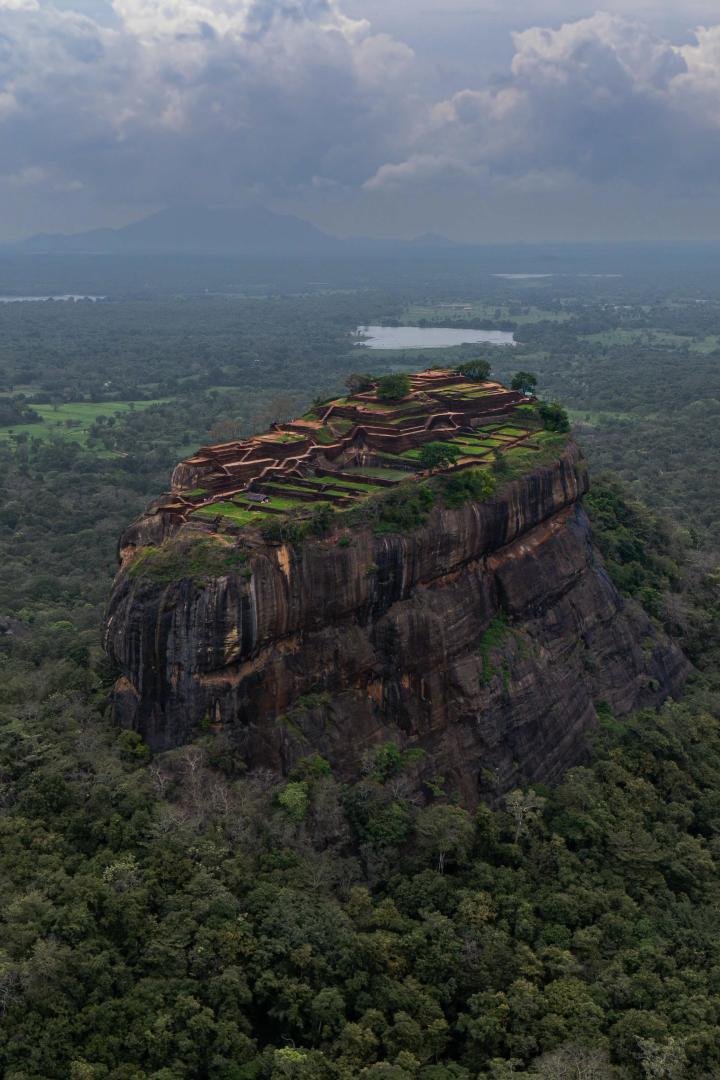
The most significant painting collection from this entire period is at Sigiriya, where 5th century frescoes survive in a sheltered rock pocket on the western face of the rock fortress. These paintings, believed to have once numbered over five hundred figures across a vast stretch of the rock face, show women carrying flowers, painted with remarkable confidence and realism. Today, around nineteen figures remain. They are considered the earliest surviving examples of classical realism in Sri Lankan art, and they are regarded internationally as a distinct tradition from the Ajantha cave paintings of India, despite some surface similarities.
Where to see them: Sigiriya Rock Fortress, North Central Province. The frescoes are located approximately 100 metres above ground on the western face of the rock, accessed by a spiral metal staircase. For more on Sigiriya, see our full Sigiriya Rock Fortress guide on the Glimpse of Lanka blog.
2. The Polonnaruwa Period: 11th to 13th Century AD
When the capital shifted from Anuradhapura to Polonnaruwa in the 11th century, the painting tradition continued but took on a new character. The finest surviving examples from this period are inside the Thivanka Image House, a 12th century shrine that presents some of the most carefully planned murals in Sri Lankan history.
The Thivanka paintings illustrate Jataka stories in the antechamber and scenes from the Buddha's own life in the inner sanctum. What makes them distinctive is the organisation: the choice of which story goes where, and how the painted space is divided to guide a devotee through a visual narrative, was clearly deliberate. Scholars consider these murals the highest expression of the late classical painting style, combining the refined line work inherited from Sigiriya with a new, more storytelling oriented approach. Some figures in the chamber are three dimensional in treatment, while the Jataka scenes in the antechamber are rendered in a flatter, more diagrammatic style, possibly the work of different artists, or a deliberate stylistic contrast between the sacred interior and the narrative outer spaces.
Where to see them: Thivanka Image House, Polonnaruwa Archaeological Site, North Central Province.
3. The Kandyan Period: 17th to Early 19th Century AD
After a gap of several centuries with few surviving works, Sri Lankan mural painting re-emerged strongly during the Kandyan period, driven by a major revival of Buddhism under the patronage of King Keerthi Sri Rajasinghe (1747–1781) and the senior monk Welivita Saranankara Sangaraja. Dozens of temples were commissioned or restored, and their image houses filled with new murals.
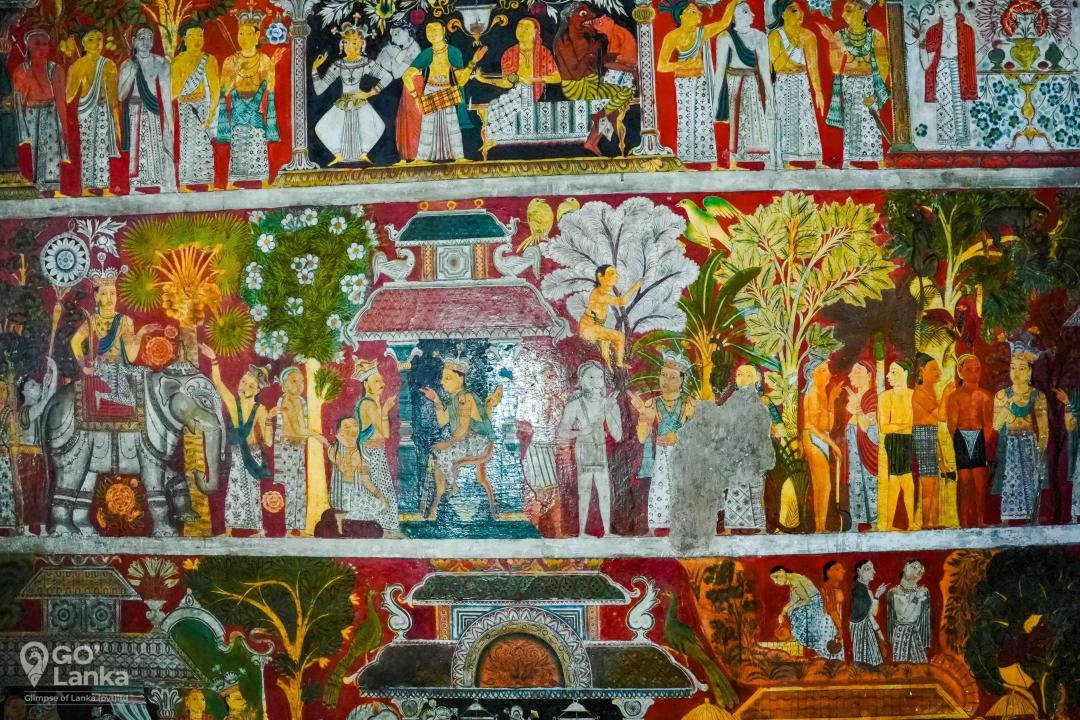
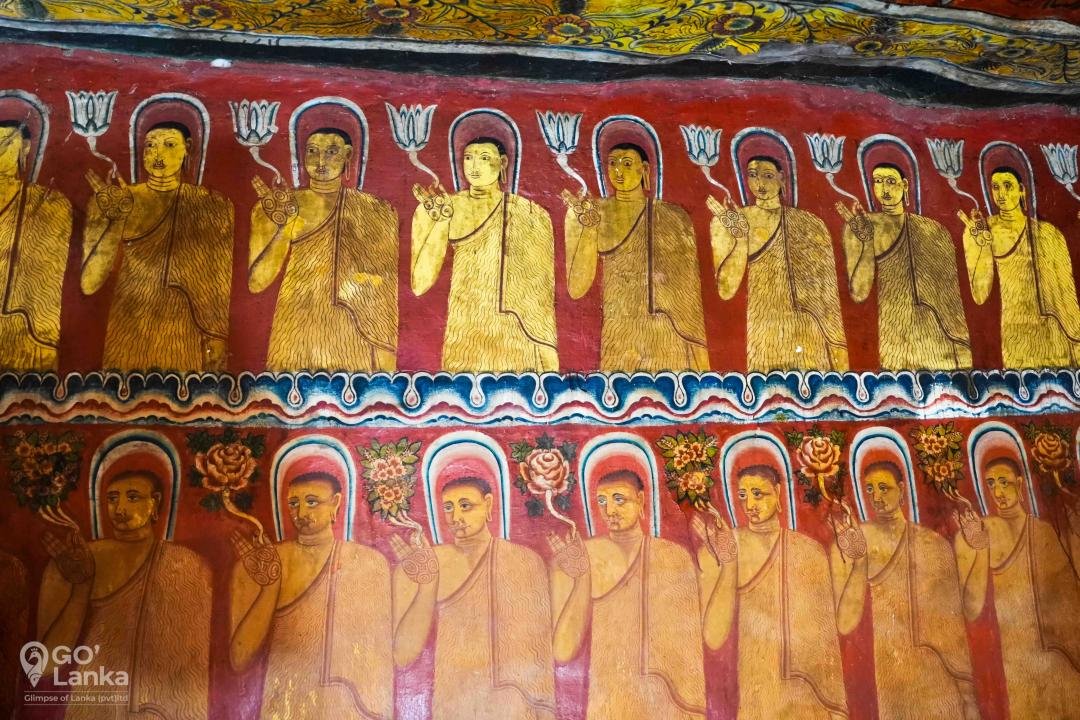
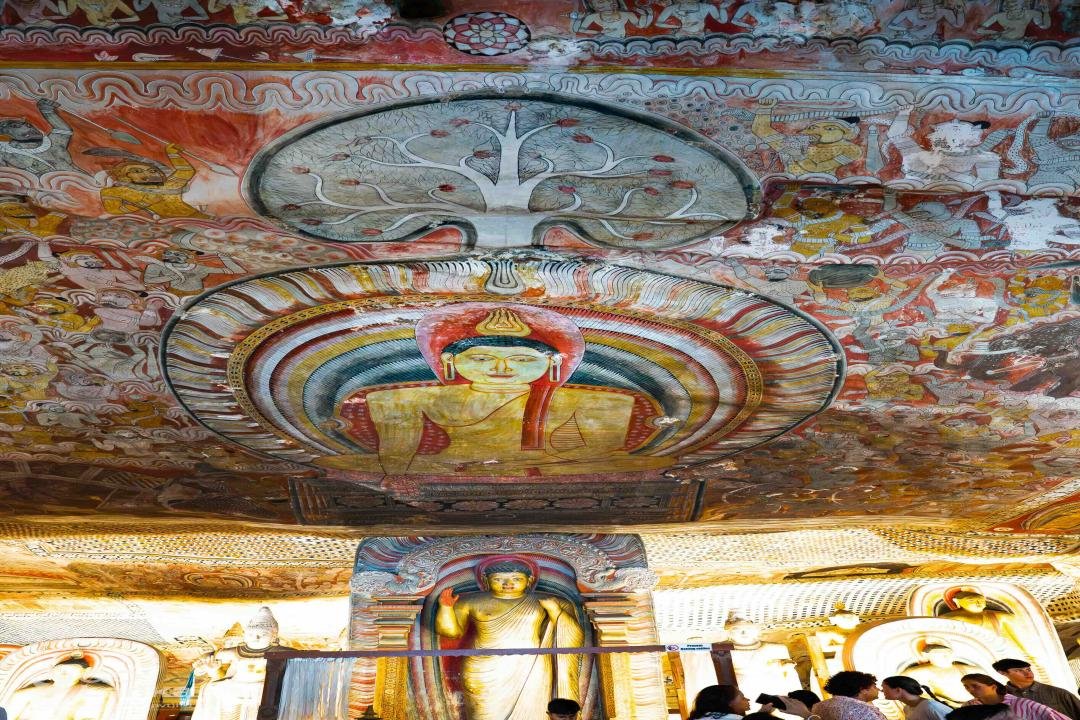
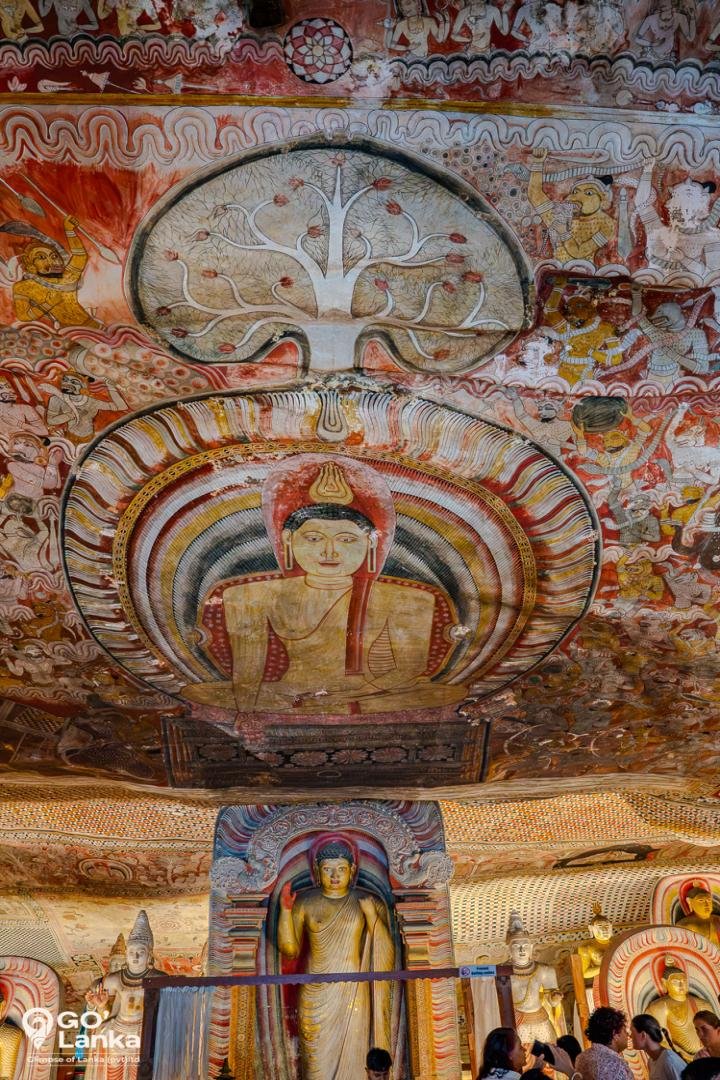
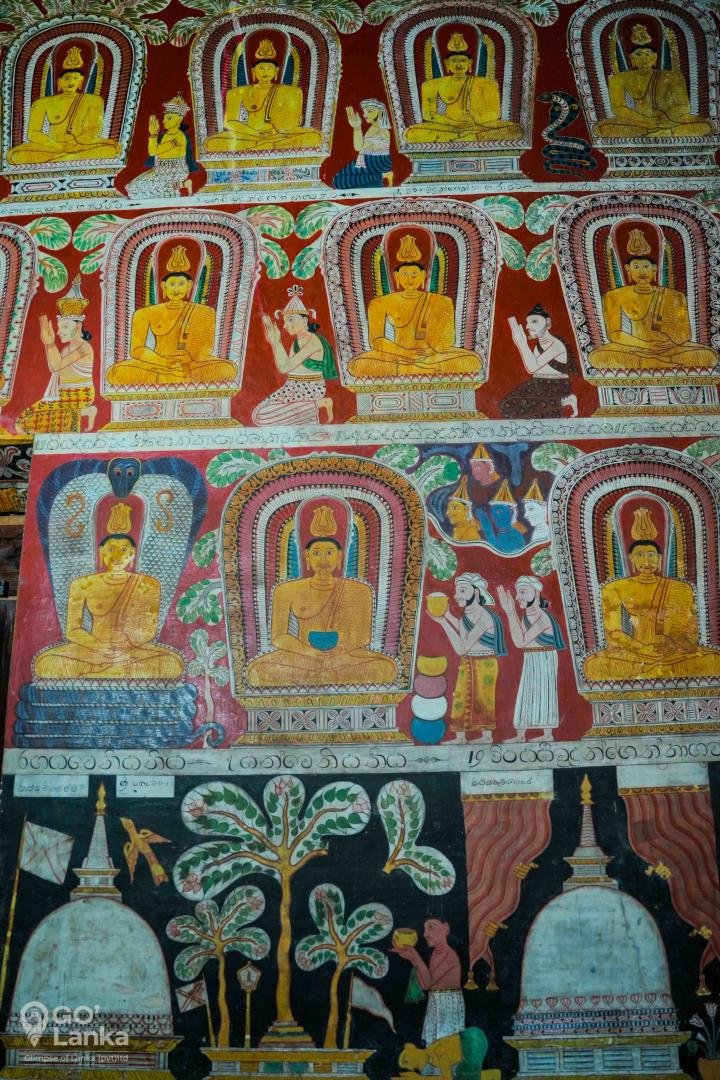
The Kandyan style is immediately recognisable. Where the Sigiriya and Polonnaruwa paintings had a classical, proportioned quality, Kandyan murals are more direct and narrative in character. Figures are sometimes disproportionate; a man may stand taller than an elephant, but what they lose in classical refinement, they gain in storytelling energy. These were paintings made for village devotees who came to the temple to hear and see the Jataka stories, and the painters understood their audience. The murals at Dambulla Cave Temple, painted between around 1700 and 1915 and covering more than 2,500 square metres across five caves, are the single largest preserved group of this tradition. They depict the Buddha's life, key events in Sri Lankan Buddhist history, and vast arrays of Buddha figures. The five caves of Dambulla also show a range within the Kandyan school itself, from the accomplished professional work in Cave 2 to the more vernacular folk style of Cave 3.
Other well preserved examples of Kandyan period painting can be found at Degaldoruwa (dated 1771–1786), Medawela, Suriyagoda, and Gangarama temples, all within or close to Kandy.
Where to see them: Dambulla Cave Temple (the largest and most accessible collection), and the temples around Kandy. See our dedicated Dambulla Cave Temple guide on the Glimpse of Lanka blog for more details.
4. The Colombo Period: Late 19th Century Onwards
The final major period of Sri Lankan mural tradition began in the late 19th century, when a new generation of artists working in the southern maritime region and later in Colombo began to introduce European influenced realism into temple painting for the first time. The style that emerged combined traditional narrative subject matter, Jataka stories, and the Buddha's life, with a more theatrical, three dimensional visual language influenced by colonial era drama and illustration.
The most significant examples are in Colombo. At Subodharama Vihara in Dehiwela, late Kandyan and early Colombo styles appear side by side in the same complex, making it a useful place to observe the transition. The murals at Kelaniya Raja Maha Vihara represent a later development of this period, with a sophisticated personal style that draws on medieval Sri Lankan sources rather than purely European ones. These Kelaniya murals cover an enormous area of the image house and its corridors, depicting historical events from Sri Lankan Buddhist history alongside Jataka stories and scenes from the Buddha's life.
Where to see them: Kelaniya Raja Maha Vihara (approximately 15 km northeast of Colombo city centre) and Subodharama Vihara, Dehiwela.
Techniques and Materials
Understanding how Sri Lanka's traditional painters worked adds a layer of appreciation when you stand in front of the murals themselves.
Fresco Buono-Sigiriya
The Sigiriya paintings were created using a technique known as Fresco Buono, or wet plaster painting. Pigments were applied directly onto a freshly laid lime surface while it was still wet. As the plaster dried, a chemical reaction between the lime and the pigments locked them permanently into the surface. This process demanded speed and confidence; mistakes could not be corrected. A figure in the Sigiriya paintings that appears to have three hands is direct evidence of this: the artist painted an unsatisfactory hand position and had no way to erase it before the plaster set.
Tempera (Fresco Secco)- Dambulla and Kandyan Temples
The Kandyan period paintings, including those at Dambulla, used a different technique: Tempera, also called Fresco Secco, or dry plaster painting. Here, pigments were mixed with a binding agent and applied to a dry plaster surface. This gave painters more time to work and allowed corrections and adjustments during the painting process. The plaster base at Dambulla was made from clay mixed with fine sand, and the binding agent used was a resin extracted from the rock apple tree (Aegle marmelos). A varnish made from the oil of the Dorana tree bark was applied over the finished paintings to preserve them and protect against insects.
Natural Pigments
Across all periods, Sri Lankan painters produced their own colours entirely from natural sources:
⬩ Red - from red ochre, an iron oxide mineral
⬩ Yellow - from yellow ochre or a mineral known as sadilingam
⬩ White - from kaolin clay or butter clay
⬩ Black - from lamp soot or burnt cotton cloth soaked in coconut oil
⬩ Blue - from the bark of the nil averiya plant (Indigofera tinctoria), ground with king coconut water
⬩ Brown and orange - from gravel and natural earth minerals
Brushes were made from natural plant fibres, including pandanus (Pandanus kaida), and fine cat fur was used for the most detailed work. Colour preparation rooms, known as Alepana Kuti, existed within monastery complexes; the remains of one can still be seen within the Abhayagiri Monastery at Anuradhapura.
Frequently Asked Questions
Which site has the best surviving traditional paintings in Sri Lanka?
Dambulla Cave Temple has the largest and best-preserved collection, covering over 2,500 square metres across five caves. For the earliest and most historically significant paintings, Sigiriya offers the only surviving examples of 5th century Sri Lankan classical art. Kelaniya Raja Maha Vihara near Colombo is the best place to see the Colombo period tradition.
Are these paintings still being created today?
Yes. Hereditary artist families have maintained the mural tradition continuously. Descendants of the Nilangama Sittara family, who were responsible for the Dambulla paintings during the Kandyan period, still practise traditional mural painting today. Contemporary artists also work in both traditional and transitional styles across temples throughout Sri Lanka.
Can visitors photograph the paintings?
Photography is generally permitted inside Dambulla Cave Temple and at most Kandyan period temples, though flash photography is not allowed near paintings as it can cause damage over time. At Sigiriya, photography of the frescoes is permitted without flash from the viewing platform. Always follow the instructions of the site staff.
Plan Your Cultural Journey with Glimpse of Lanka
Sri Lanka's traditional paintings are not simply historical artefacts. They are active parts of living temple complexes, still surrounded by devotees, still accumulating the slow patina of incense and time. Visiting them in the right order and with the right context transforms them from interesting old walls into a two thousand year conversation about faith, beauty, and artistic skill.
If you would like help planning a trip that brings this tradition to life, combining Sigiriya, Dambulla, Kandy, and Colombo into a coherent cultural itinerary, our team at Glimpse of Lanka can put together a tailor-made plan based on your interests and travel dates. Fill in our tailor-made itinerary form, and we will take care of the rest.