The Ancient City of Anuradhapura: Sri Lanka's First and Greatest Kingdom
Anuradhapura is one of the oldest continuously inhabited cities in Asia and the first great capital of Sri Lanka. For more than 1,500 years, from around the 4th century BC to the 11th century AD, it was the political, religious and cultural heart of the island. Today it stands as a UNESCO World Heritage Site, its ancient stupas, sacred trees and monastery ruins spread across a landscape that has barely changed in outline since the days of its greatest kings.
Visiting Anuradhapura is not simply a matter of ticking off monuments. It is a chance to stand inside a civilisation that built some of the largest brick structures in the ancient world, engineered water systems that still function today, and kept a living tree rooted for over 2,300 years. This guide covers the history, the key monuments, and everything you need to know before you visit.
A Kingdom That Lasted 1,500 Years
Anuradhapura sits in the dry zone plains of Sri Lanka's North Central Province, on the banks of the “Malwathu Oya”river. The area has been inhabited since at least the 9th century BC, and excavations in the inner citadel have unearthed iron tools, paddy chaff, and signs of a settled agricultural civilisation dating back more than 2,800 years. By the 4th century BC, a recognisable kingdom had emerged here, and it would endure through invasions, religious upheavals, and dynastic changes until the Chola invasion of 1017 AD finally shifted the capital south to Polonnaruwa.
At its height, Anuradhapura was a fully planned city. The inner citadel contained palaces, temples and administrative buildings. The outer city held residences for merchants, craftsmen, soldiers and scholars. Luxury houses for foreign traders stood within the city walls, and the main road ran 57 feet wide. The Chinese monk Fa-Hsien, who lived here for two years in the early 5th century AD, described it as a wealthy city with multistoried buildings, richly adorned houses, oil lamp lit streets, underground piped water and an efficient sewage system. It also traded actively with Rome, Persia, Arabia, China and India.
What made this possible was water. Anuradhapura's kings built an unsurpassed network of reservoirs and irrigation canals across the dry zone plains, feeding agriculture and supplying the city itself. Several of the ancient tanks Tissa Wewa, Nuwara Wewa and Basawakkulama still hold water today, a quiet testament to engineering that is well over two thousand years old.
Buddhism arrived in Anuradhapura in 247 BC, when “Arahath Mahinda Thera”, son of the Indian Emperor Asoka, met King “Devanampiyatissa” on the hill of Mihintale, 15 km to the east of the city. The king embraced the teaching, and Buddhism spread rapidly across the island. From that moment, Anuradhapura became one of the great centres of Theravada Buddhism in the world, a role it maintained for a thousand years. The monastery complexes that grew here Mahavihara, Abhayagiri and Jetavanaramaya became international institutions, attracting monks and scholars from India, China, Java and Kashmir.
What You Will See Today
Anuradhapura's ancient city covers a large area, and the main monuments are spread across it. Most visitors hire a bicycle or tuk-tuk at the entrance to the archaeological park, which is the most practical way to move between sites comfortably. Allow at least a full day, preferably two, to visit the main monuments without rushing.
Sri Maha Bodhi: The Oldest Recorded Tree in the World
The Sri Maha Bodhi is the second most sacred Buddhist site in Sri Lanka, after the Temple of the Tooth Relic in Kandy. It is a fig tree Ficus religiosa grown from a sapling of the original Bodhi tree in Bodh Gaya, India, under which the Gautama Buddha attained enlightenment. The sapling was brought to Sri Lanka in 247 BC by “Bikkhuni Sangamitta”, the sister of Arahath Mahinda Thera, on the orders of Emperor Asoka.
According to the British colonial historian Sir James Emerson Tennant, writing in 1867, this is the oldest historically documented tree planted by a human hand anywhere in the world. That record has never been challenged. The tree has grown continuously on this spot for over 2,300 years, outlasting every dynasty that ever ruled Sri Lanka. It is protected today by a golden fence, the first of which was erected by Buddhist devotees in 1969, and its health is monitored monthly by the Director of the Royal Botanic Gardens at Peradeniya.
The original Bodhi tree at Bodh Gaya was destroyed centuries ago. A sapling from the Sri Lankan tree was sent back to India in 1880 to restore it. In other words, the tree that stands in Anuradhapura today is the ancestor of the one that now grows at Bodh Gaya. For Buddhists and history minded travellers alike, standing beneath it is a rare experience.
Ruwanvelisaya: The Great White Stupa
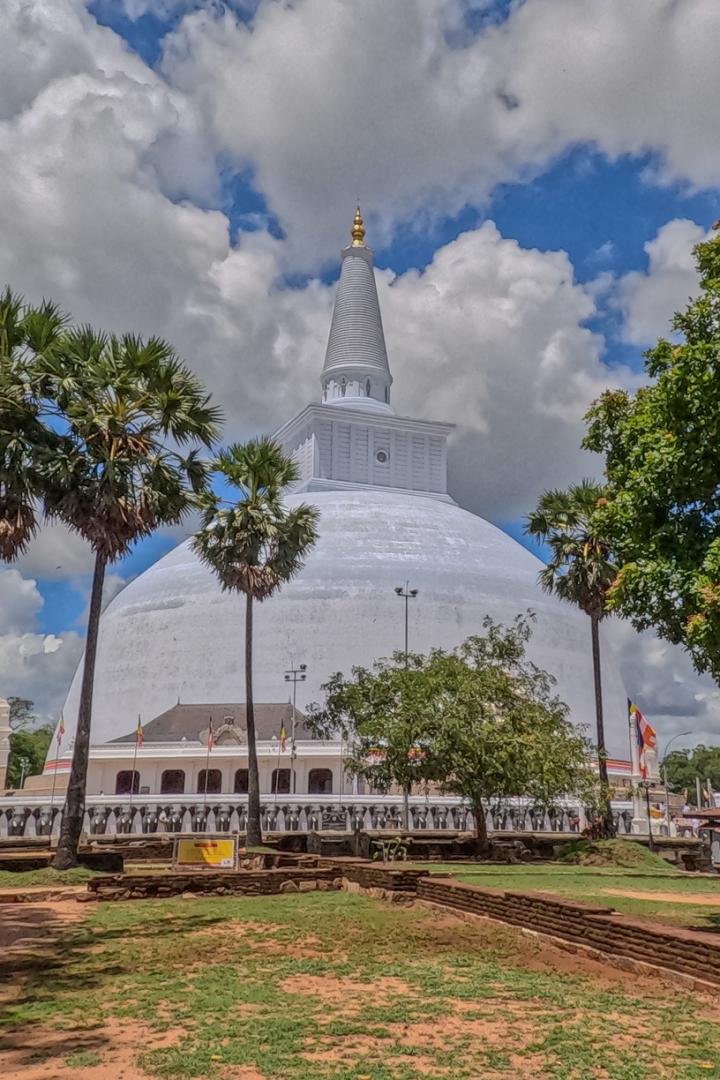
The Ruwanvelisaya is Anuradhapura's most iconic monument. Built by King “Dutugemunu” between 161 and 137 BC, this great white stupa rises to a height of around 103 metres and has a circumference at the base of over 290 metres. A bowl of the Buddha's bodily relics was enshrined inside it at the time of its construction, and the ceremony of foundation laying was attended by delegations from major cities across India, from Alexandria in Greece, and from Kashmir.
Walking around the base of Ruwanvelisaya, you pass the elephant wall, a frieze of 344 stone elephant figures, each standing around 9 feet tall, encircling the stupa. These represent the eight cosmic elephants said in Vedic tradition to hold up the universe. A few of the original stone elephants survive at the western gate. What you see for the rest of the circuit are restoration work from various periods. The stupa itself has been restored many times over the centuries, most recently beginning in 1872, when the project was supported by both Sri Lankan and Burmese Buddhists.
Jetavanaramaya: The World's Tallest Brick Structure
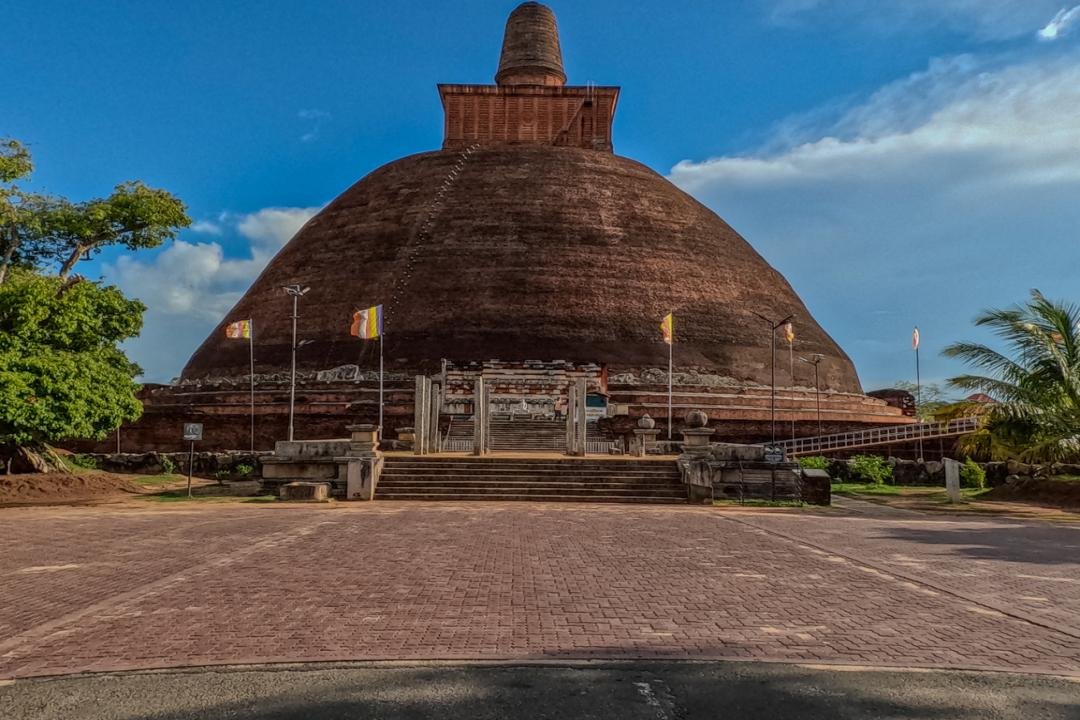
When King “Mahasen” built the Jetavanaramaya stupa in the 3rd century AD, it stood over 120 metres high, making it, at that moment, the third tallest structure in the world, behind only the two great pyramids at Giza. Unlike the pyramids, it was built entirely of brick. An estimated 93 million bricks were used in its construction, their composition precisely calibrated: 60 percent fine sand, 35 percent clay, with a bonding strength that archaeologists have measured as still meeting modern engineering standards.
The 19th century British colonial secretary Emerson Tennant calculated that if you laid the bricks from Jetavanaramaya end to end, they would build a wall three feet high and one foot wide stretching from Edinburgh to London. The stupa today stands at around 71 metres, reduced from its original height by centuries of jungle, decay and partial collapse. But even in its reduced state, its scale is hard to fully absorb. The stupa complex covers 8 acres, and the four entrance gateways are each 28 feet wide.
Jetavanaramaya was also the centre of one of Anuradhapura's three great monastery fraternities, the Sagalika sect, which practised a more open and syncretic form of Buddhism than the orthodox Mahavihara. Recent excavations have found golden plates inscribed with Mahayana texts, Chinese ceramic containers likely used as medicine vessels, and the remains of foundries, workshops and a large chapter house. The site's museum houses many of the finest finds.
Abhayagiri: The Monastery That Taught the World
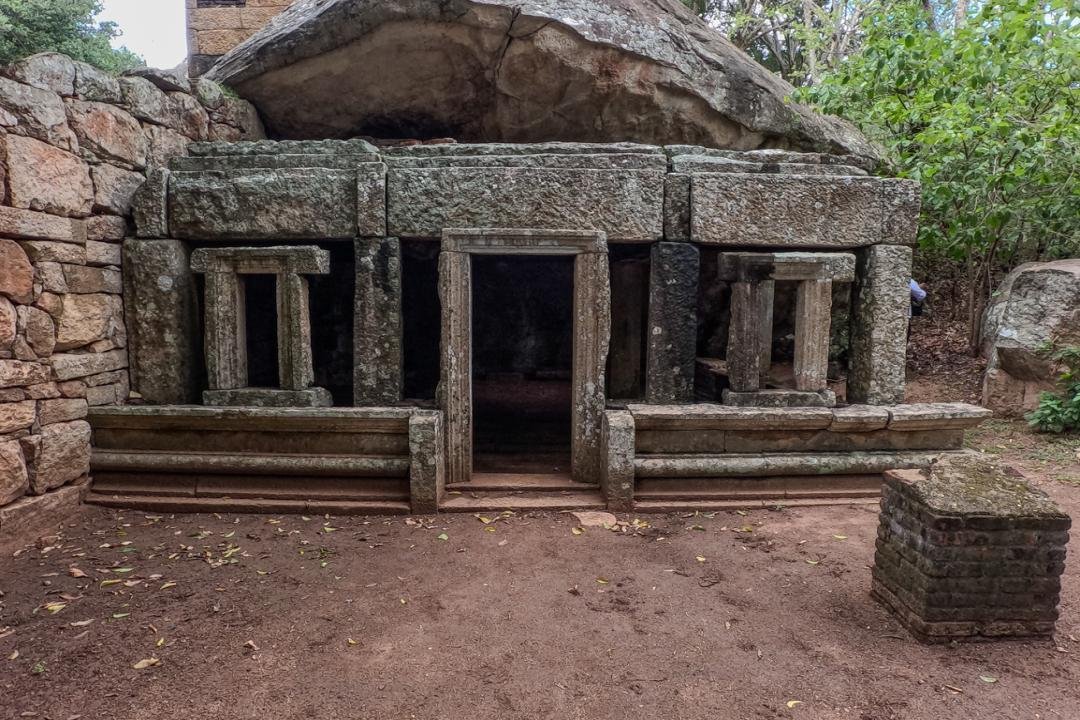
Abhayagiri was built by King “Valagamba” in 89 BC, and by the early centuries AD it had grown into one of the most significant Buddhist institutions in Asia. Fa-Hsien described it as home to five thousand monks. It covered 500 acres and functioned as a full university, with four faculties teaching subjects including Theravada and Mahayana Buddhism, medicine, astrology, architecture, six languages including Pali and Sanskrit, fine arts, and rhetoric. Its influence reached China, Java, Kashmir, Thailand and beyond.
The Abhayagiri stupa, the second largest in Anuradhapura, stands 75 metres high today. Its four frontispieces, decorative face-structures on the cardinal points, were added by King Gajabahu in the 2nd century AD. At the southern entrance, two guardian figures, Sankanidhi and Padmanidhi, remain in remarkable condition. Near the stupa, visitors can find the famous Elephant Pond, a man made tank equivalent in volume to six Olympic swimming pools, carved and faced entirely in dressed stone. The underground conduits that fed it with filtered water from nearby reservoirs can still be traced.
Perhaps the most quietly arresting sight at Abhayagiri is the “Samadhi” Buddha statue, found in the “Mahamewna”gardens nearby. Carved from dolomite marble, this 4th to 5th century figure shows the Buddha in deep meditation. It is admired internationally as one of the finest depictions of meditative serenity in the history of Buddhist sculpture.
Isurumuniya: Rock Carvings by the Water
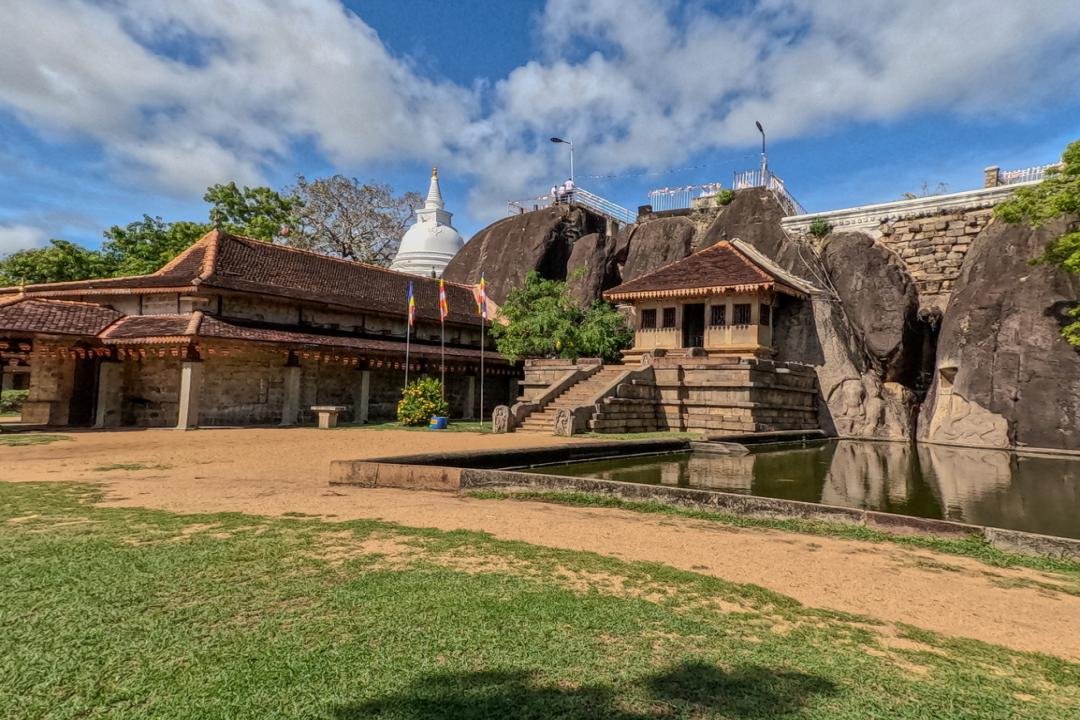
Isurumuniya is smaller and quieter than the great stupas, but it offers something the others do not: close-up stone carvings of exceptional quality. The temple sits beside the Tissa Wewa reservoir, and the site has been a place of Buddhist worship since at least the pre Christian era.
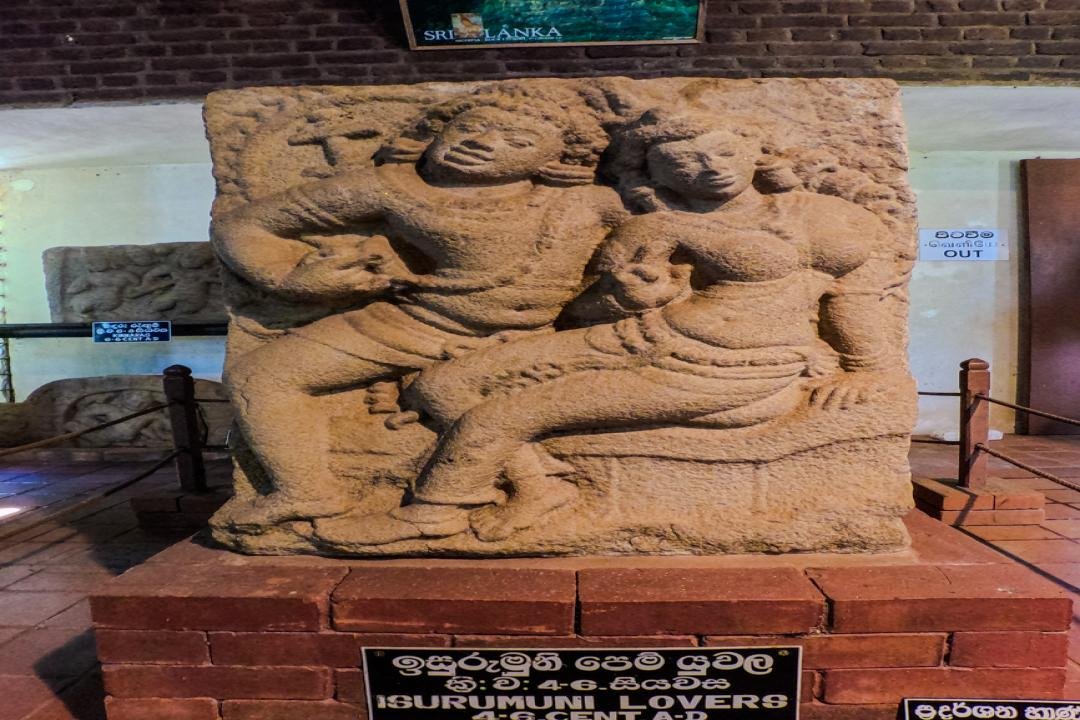
The most famous carving is the Isurumuniya Lovers, a bas relief showing a man and a woman in a moment of private tenderness. The male figure, identified by scholars as a soldier of high rank, and the female figure's posture and expression are carved with a psychological subtlety that is extraordinary for stone. Each gesture carries a precise meaning drawn from ancient Sanskrit performance texts: the angle of her head, the half closed eyes, the position of his hand. The bathing elephants carved on the rock face beside the adjacent pond are equally remarkable, full of movement and what appears to be joy. The site museum houses additional sculptures including a royal family group and a depiction that some connect to the legend of Prince Saliya and his non royal love “Asokamala”.
Practical Tips for Visiting Anuradhapura
Getting Around the Site
The archaeological park is large. Hiring a bicycle at the entrance is the most popular and enjoyable way to move between monuments at your own pace. Tuk-tuks are also widely available if you prefer a driver. Walking the full circuit is possible but tiring, particularly in the heat of the day. Most visitors spend a full day here, two days allows a more relaxed pace and time for the museum at Jetavanaramaya.
Best Time to Visit
The dry season from January to April offers the most comfortable conditions for exploring the outdoor sites. The heat builds steadily through March and April, so an early morning start, before 8 AM is advisable year round. If you are visiting during a “Poya” day (the full moon day of each month), you will find the site more crowded, particularly at Sri Maha Bodhi, but you will also see Anuradhapura at its most alive, with thousands of white clad pilgrims and a genuine atmosphere of devotion.
The “Poson Poya” in June is the most significant of all, commemorating the arrival of Buddhism in Sri Lanka. On this day, pilgrims gather in enormous numbers at both Anuradhapura and nearby “Mihintale”, the hill where Buddhism was first preached on the island. If your itinerary allows, Mihintale is worth a short separate visit, its 1,840 stone steps, ancient hospital, and cave of “Arahath Mahinda Thera” add a compelling chapter to the Anuradhapura story, and we plan to cover it in a dedicated article on the Glimpse of Lanka blog.
Dress Code and Temple Etiquette
Anuradhapura is an active place of Buddhist pilgrimage, not just an archaeological site. Modest dress is required throughout the sacred zones. Shoulders and knees must be covered, and shoes must be removed before entering temple premises. This applies both to the “Sri Maha Bodhi” enclosure and to the image houses at each monastery. Carrying a light scarf or sarong is useful if your clothing needs adjustment. Visitors are asked to behave calmly and quietly, particularly at the Sri Maha Bodhi, where devotees are often in prayer or meditation.
Frequently Asked Questions About Anuradhapura
How long should I spend in Anuradhapura?
At minimum, plan for a full day. Two days gives you a more relaxed visit, with time to explore the Jetavanaramaya museum, cycle between monuments at a comfortable pace, and spend quiet time at Sri Maha Bodhi and the Samadhi statue without rushing.
Is Anuradhapura suitable for first time visitors to Sri Lanka?
Yes. Anuradhapura is one of the most rewarding sites in the country for anyone interested in history, religion or architecture. The scale of the ancient city is genuinely impressive, and the fact that it is still an active pilgrimage site gives it a living quality that purely ruined ancient cities often lack.
Can Anuradhapura be combined with other Cultural Triangle sites?
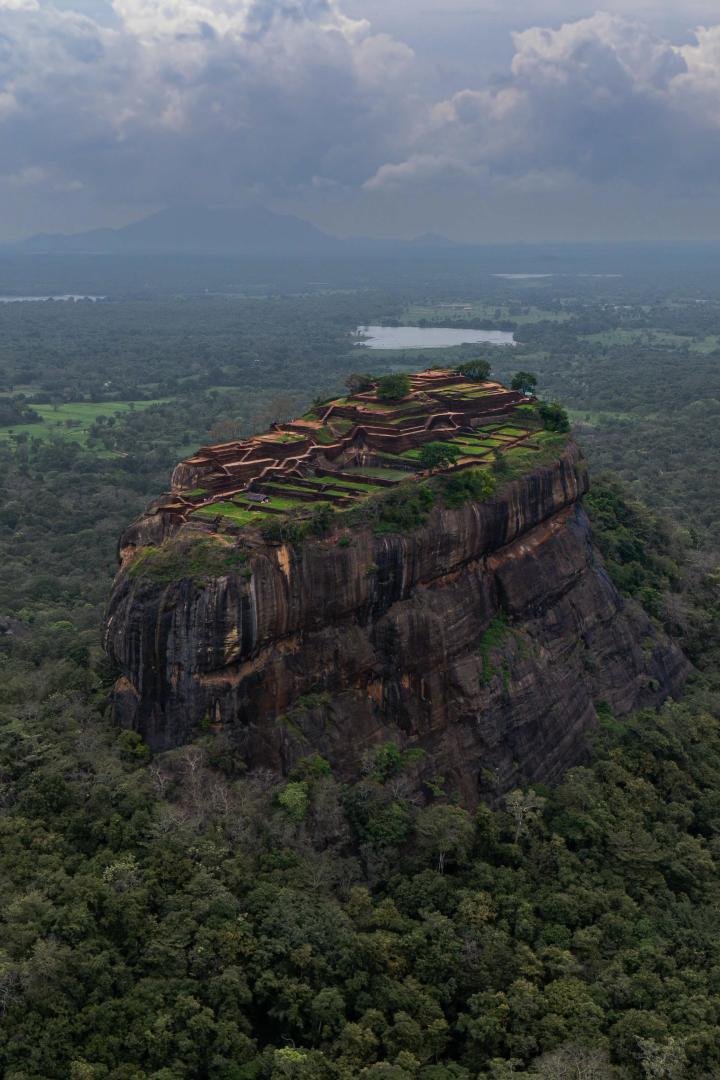
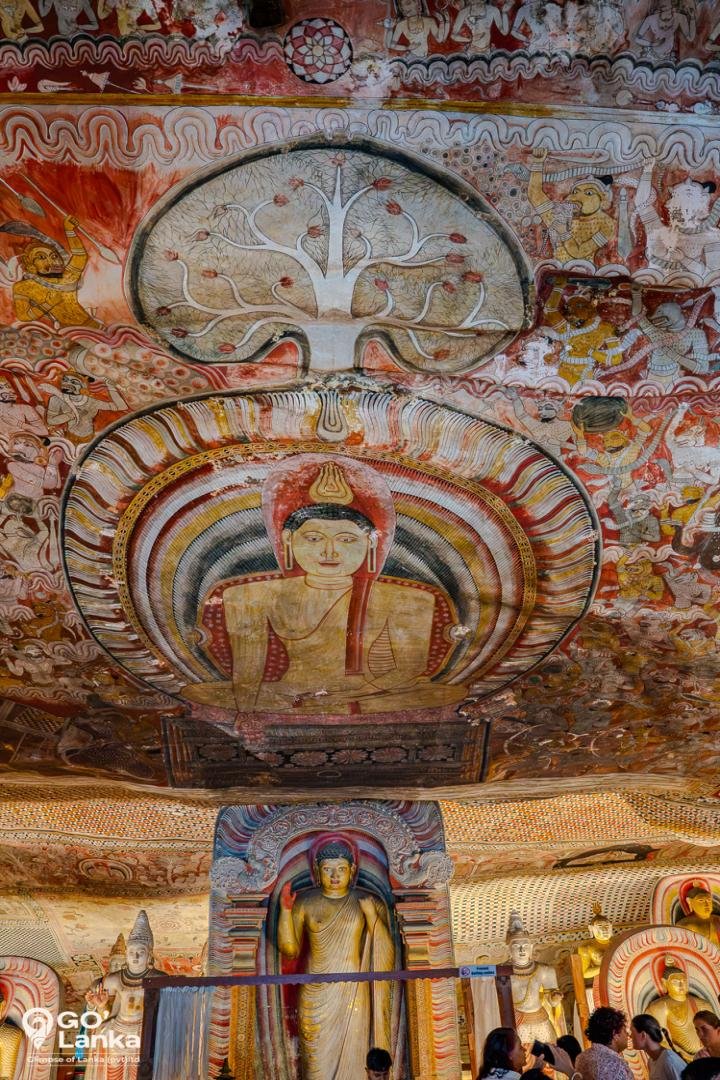
Yes. Most visitors to the Cultural Triangle include Anuradhapura together with Sigiriya, Dambulla Cave Temple, and the ancient city of Polonnaruwa. The sites are spread across the north central region and are best covered over three to four days, ideally with a base in the Habarana area.
What is the best monument to start with?
Most visitors begin at Sri Maha Bodhi and work their way through the Mahavihara complex, including Ruwanvelisaya and the Brazen Palace ruins, before moving north to Abhayagiri and Jetavanaramaya. Isurumuniya is a quieter finish to the day, particularly as the afternoon light falls across the reservoir beside it.
Plan Your Visit to Anuradhapura with Glimpse of Lanka
Anuradhapura rewards visitors who arrive with some understanding of what they are looking at. The ruins of a 1,500 year kingdom are spread across a landscape that still holds living trees, working reservoirs, and active temples. It is a place where history is not behind glass, it is still present, still used, and still venerated.
If you would like help building an itinerary that includes Anuradhapura alongside other highlights of Sri Lanka, our team at Glimpse of Lanka can create a tailor-made plan based on your interests, travel dates, and pace. Simply fill in our tailor-made itinerary form and we will take care of the rest.