
Sri Lankan Food: A Complete Guide for Visitors
From rice and curry to hoppers, kottu roti, and watalappan, everything a first-time visitor needs to know about Sri Lankan cuisine.
Sri Lankan food surprises most visitors. Travellers who expect something similar to Indian cooking quickly discover a cuisine with its own distinct character, shaped by the island's geography, its ancient spice trade, and over centuries of Portuguese, Dutch, and British colonial influence. The result is a cooking tradition that is bold in flavour, generous in variety, and unlike anything most international visitors have tried before.
Coconut is the foundation of almost every Sri Lankan dish, appearing as fresh grated flesh, thick coconut milk, or coconut oil. Spices native to the island, Cinnamon, Pepper, Cardamom, Cloves, and Nutmeg, are used in almost every curry. Sri Lanka produces the finest cinnamon in the world, known internationally as “Ceylon Cinnamon”, and its flavour in a home-cooked curry is noticeably different from the variety found in supermarkets abroad.
This guide covers the most important dishes visitors will encounter in Sri Lanka, breakfast, main meals, street food, vegetarian options, desserts, and drinks, along with practical guidance on navigating the food as a first-time visitor.
A Note on Spice
Sri Lankan food can be genuinely hot. Curries are prepared with fresh green chillies, dried red chillies, and chilli powder, and the heat level in a traditional home-cooked meal is often considerable. Visitors who are unaccustomed to spicy food should be aware of this before ordering.
Most restaurants that regularly serve tourists are well practised at adjusting heat levels on request. Asking for a dish to be prepared mild or less spicy is entirely normal and will be understood in almost any restaurant or guesthouse across the island. Specifying your preference clearly before ordering, rather than after the food arrives, produces the best results.
Sri Lankan Breakfast Dishes
Breakfast in Sri Lanka is one of the most varied and enjoyable meals of the day, and for many visitors it becomes a highlight of the trip. The traditional Sri Lankan breakfast is quite different from what most travellers are familiar with, and the dishes available are found across the country in hotels, small restaurants, guesthouses, and roadside eateries.
⬩Hoppers (Appa)
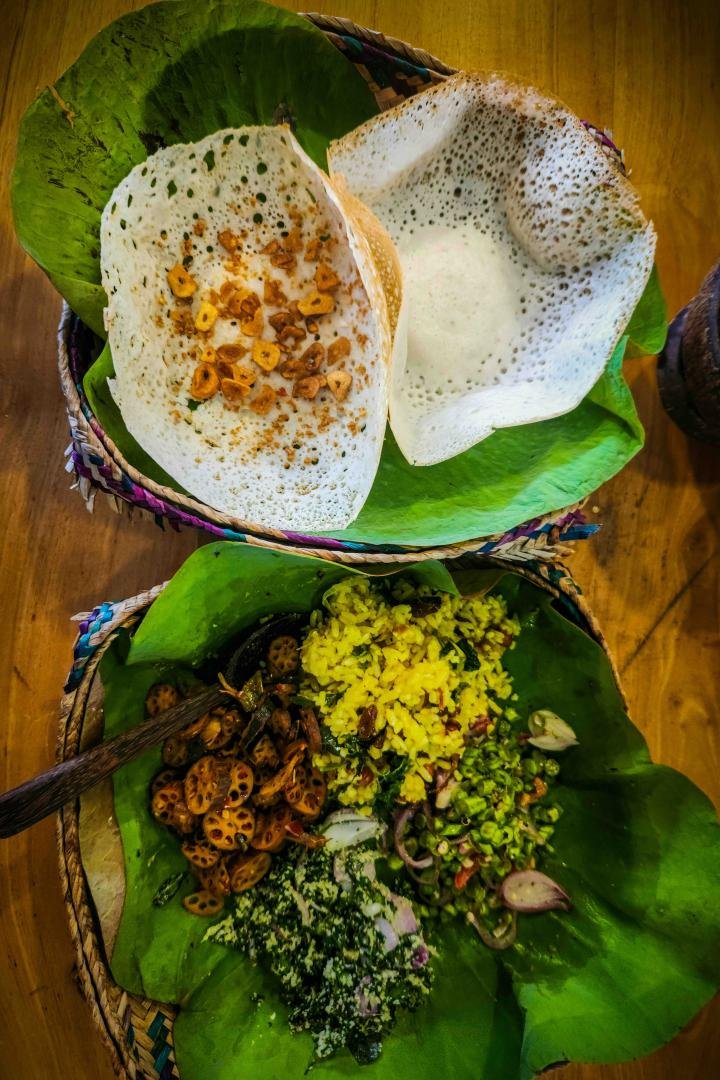
Hoppers are perhaps the most recognisable Sri Lankan breakfast dish among international visitors. They are thin, bowl-shaped pancakes made from a batter of fermented rice flour and coconut milk, cooked in a small rounded pan over high heat. The result is a crisp, lacy edge with a soft, slightly chewy centre. They are light and flavourful on their own, with a faint sourness from the fermentation process.
The most popular variety among tourists is the egg hopper, made by cracking a fresh egg into the centre of the batter while it is still cooking. The egg sets gently in the warmth of the pan, sitting inside the bowl of the hopper. Hoppers are typically served with “Lunu Miris”, a relish of chopped red onions, dried red chillies, and lime juice, along with coconut sambol and sometimes a mild curry on the side. They are available at breakfast and in the evenings at most local restaurants and hotels across Sri Lanka.
⬩String Hoppers (Idiyappa)
String hoppers are made from rice flour pressed through a mould to form fine, delicate noodle rounds, which are then steamed. They are soft, mild in flavour, and served in small stacks alongside dhal curry, coconut sambol, and occasionally a thin meat or fish curry. String hoppers are best eaten fresh, as they become dry quickly after cooking. They are a common breakfast choice across the island and are suitable for visitors who prefer a milder introduction to Sri Lankan flavours.
⬩Milk Rice (Kiri Bath)
Kiri bath is rice cooked in thick coconut milk until it reaches a dense, creamy consistency, then pressed flat and cut into square or diamond shaped portions. The name translates directly as milk rice. It has a mild, subtly sweet flavour and is often served with lunu miris or a sharp coconut sambol that provides contrast to its richness.
Kiri bath carries deep cultural significance in Sri Lanka. It is traditionally prepared on the first day of each month, on the Sinhala and Tamil New Year in April, and at weddings and other important celebrations. Visitors will find it on the menu at most traditional Sri Lankan restaurants and guesthouses, particularly in the morning.
⬩Coconut Flatbread (Pol Roti)
Pol roti is a thick, slightly chewy flatbread made from wheat flour and freshly grated coconut, cooked on a dry griddle. It is denser and more filling than a standard roti, with a characteristic texture from the coconut running through it. It is typically served with lunu miris or a fresh coconut sambol, and sometimes alongside a curry. Pol roti is a common breakfast item and is also eaten throughout the day as a snack.
⭑ Rice and Curry - The Heart of Sri Lankan Food
Rice and curry is not a single dish but a way of eating that forms the centrepiece of Sri Lankan lunch and dinner. A typical meal consists of a large portion of steamed rice surrounded by several small portions of curry, each different in flavour, heat level, and main ingredient. A standard plate might include a dhal curry, a fish or chicken curry, a vegetable curry such as jackfruit, beetroot, or green beans, a mallum of finely chopped leaves, a coconut sambol, and a papadum on the side.
The curries are prepared using Sri Lanka's distinctive roasted curry powder, a blend of coriander, cumin, fennel, cinnamon, cloves, cardamom, and chilli that is roasted before grinding, giving it a darker colour and smokier flavour than Indian curry powder. Coconut milk is added to most curries toward the end of cooking to soften the heat and add richness.
No two rice and curry meals are exactly the same. Each household, each small restaurant, and each region has its own proportions and combinations. Eating rice and curry at a small family-run eatery, known locally as a hotel regardless of its size, gives visitors the most authentic experience of everyday Sri Lankan cooking.
Sri Lankan Street Food
⬩Kottu Roti
Kottu roti is the most popular street food in Sri Lanka and one of the most recognisable dishes on the island. It is made by chopping up a thin, stretchy flatbread on a large flat iron griddle alongside vegetables, egg, and a choice of protein, which may be chicken, beef, mutton, or cheese for vegetarians. The ingredients are mixed and chopped together using a pair of long metal blades, which produce a loud rhythmic clanging sound that carries down the street and announces the kottu stall long before it comes into view.
Kottu is typically served with a small portion of curry gravy on the side. It is filling, flavourful, and available in most towns across Sri Lanka from early evening onwards. Visitors can specify chicken, vegetable, or cheese kottu if they prefer to avoid red meat, and can request a milder version by asking for less chilli.
⬩Short Eats - Sri Lankan Snacks
Short eats is the local term for the range of small fried and baked snacks sold at bakeries, tea shops, and street stalls across the island. They are an important part of everyday food culture and are eaten at any time of day alongside a glass of milk tea. Common varieties include:
∘ Rolls - a thin pancake filled with spiced potato and meat or fish, rolled and deep-fried until golden
∘ Cutlets - spiced potato and meat croquettes, coated in breadcrumbs and fried
∘ Isso vadai - a fried lentil patty topped with a whole prawn, popular along the coast
∘ Seeni sambol buns - soft bread rolls filled with a sweet and spicy caramelised onion relish
Short eats are inexpensive, filling, and available everywhere from small bakeries to roadside carts. They are an easy way to eat well between meals without committing to a full sit-down service.
⬩Lamprais - A Dutch Burgher Legacy
Lamprais is one of the most historically interesting dishes in Sri Lanka. It consists of rice cooked in meat stock, accompanied by several curries, a blanchan paste made from dried shrimp, seeni sambol, and a frikadel, a spiced meat patty with Dutch origins. All of the components are wrapped together inside a banana leaf parcel and baked in an oven. The banana leaf infuses the food with a faint herbal aroma and keeps everything moist during baking.
The dish is believed to have originated among the Dutch Burghers, a community of mixed Dutch and Sri Lankan descent that formed during the colonial period. The name comes from the Dutch lomprijst, meaning a parcel of rice. Lamprais is most commonly found in Colombo and in restaurants that specialise in Burgher cuisine. It is served and eaten straight from the banana leaf parcel, which adds to the experience of the dish.
Vegetarian and Vegan Food in Sri Lanka
Sri Lanka is a comfortable destination for vegetarian and vegan travellers. A significant proportion of the Sri Lankan population follows a vegetarian diet for religious reasons, and vegetable curries, dhal, and coconut based dishes are central to everyday cooking rather than an afterthought.
A standard rice and curry meal can easily be requested as vegetarian, with curries of dhal, jackfruit, pumpkin, beetroot, green beans, aubergine, and several varieties of leaf preparation. String hoppers, hoppers, kiri bath, and pol roti are all naturally vegetarian. Coconut sambol and lunu miris, served alongside most meals, are also plant-based.
Vegans should be aware that ghee and eggs are used in some preparations. It is worth specifying no eggs and no ghee when ordering, particularly with hoppers. Most guesthouses and restaurants catering to tourists will accommodate this without difficulty. Maldive fish, dried and cured tuna, is a traditional flavouring used in some sambols and relishes, so vegans should confirm whether it is included when ordering items like pol sambol.
Sri Lankan Desserts and Sweet Dishes
⬩Watalappan
Watalappan is a steamed coconut custard made from eggs, thick coconut milk, and kithul jaggery, a dark, unrefined palm sugar produced from the sap of the fishtail palm. It is spiced with cardamom, nutmeg, and sometimes cloves, and is often garnished with cashew nuts. The texture is smooth and dense, similar to a baked custard, with a deep caramel flavour from the jaggery.
Watalappan is believed to have arrived in Sri Lanka with the Malay community during the period of Dutch colonial rule in the 18th century. It has since become a staple dessert across the island and holds particular significance within the Sri Lankan Muslim community, where it is traditionally prepared during Ramadan and Eid. It is now widely available in restaurants and hotels throughout Sri Lanka.
⬩Buffalo Curd and Kithul Treacle
Buffalo curd with kithul treacle is one of the simplest and most beloved combinations in Sri Lankan food. The curd is made from the milk of the water buffalo and has a thick, creamy texture and a mild sourness. It is served in small earthenware pots and drizzled generously with kithul treacle, the same dark palm syrup used in watalappan, which provides a deep, almost smoky sweetness. The combination is served as a dessert and is also eaten at breakfast. It is available at traditional Sri Lankan restaurants and at roadside stalls near areas where buffalo curd is produced, particularly in the hill country and dry zone.
⬩Kavum and Kokis
Kavum and kokis are traditional Sri Lankan sweets associated with the Sinhala and Tamil New Year celebrations in April, though they are available year round in bakeries and sweet shops. Kavum are deep fried rice cakes made from rice flour, treacle, and coconut milk, with a crisp exterior and a dense, slightly sweet interior. Kokis are thin, crispy fried biscuits made from rice flour and coconut milk, shaped using an intricately carved iron mould dipped in hot oil. Both are ancient preparations that have remained largely unchanged for centuries.
Drinks in Sri Lanka
⬩King Coconut (Thambili)
The king coconut, known locally as thambili, is a smaller, orange skinned variety of coconut found only in Sri Lanka and parts of southern India. The water inside is lighter and sweeter than that of the green coconut, and is sold by street vendors across the island who cut the top open with a single stroke of a machete and insert a straw. King coconut water is rich in electrolytes and is one of the most refreshing drinks available in the tropical heat. Visitors will find thambili sellers at roadsides, markets, and near tourist sites throughout the country.
⬩Ceylon Tea
Ceylon tea is one of Sri Lanka's most significant exports and one of the most recognised teas in the world. Grown in the central hill country at elevations between approximately 600 and 2,200 metres, it is produced in a range of styles from light and golden to full bodied and deep amber. The tea growing regions of Nuwara Eliya, Dimbula, and Uva each produce teas with distinct character, shaped by altitude, rainfall, and the direction of the prevailing winds.
Tea is served throughout the day in Sri Lanka, from early morning through to late evening. In most local restaurants and households, it is prepared strongly, with milk and sugar already added. Visitors who prefer their tea without milk or sugar should specify this when ordering. Visiting a working tea estate in the hill country and drinking a fresh cup at the factory is one of the most straightforward and memorable food experiences available anywhere on the island.
⬩Ginger Beer and Fresh Juices
Local ginger beer, made with Sri Lankan ginger and a natural carbonation process, is a popular drink with meals and on its own. Fresh fruit juices made from woodapple, mango, lime, and passion fruit are widely available at local restaurants and juice bars. Woodapple juice, made from the thick, fragrant pulp of the woodapple fruit blended with coconut milk and jaggery, is distinctive to Sri Lanka and worth trying on its own terms.
Restaurant Dining and Street Food: What to Expect
Sri Lanka offers a wide range of dining settings, from small roadside eateries and local rice and curry restaurants to boutique hotel dining rooms and beachside restaurants. The food experience differs significantly between these settings, and both have their own value.
Local rice and curry restaurants serve fixed meals at lunchtime that are fresh, inexpensive, and cooked that morning. The portions are generous, the variety is wide, and the quality is generally excellent. These restaurants are found in every town and village across the island. Pointing to the dishes behind the counter and indicating how much you would like is the standard way to order.
Street food stalls serving kottu, hoppers, and short eats are busiest in the evenings and are found in most town centres. They are generally clean, fast, and inexpensive. Choosing a busy stall with high customer turnover is the best indicator of quality and freshness.
Tourist-oriented restaurants in areas such as Colombo, Galle, Ella, and Kandy offer Sri Lankan dishes alongside international menus. These establishments are more accustomed to adjusting dishes for dietary requirements and spice preferences, and typically offer English menus. The food quality varies widely, and eating where locals eat rather than where other tourists eat almost always produces better results.
Explore Sri Lanka with Glimpse of Lanka
Food is one of the most memorable parts of any visit to Sri Lanka, and the best experiences are usually found off the tourist trail and away from resort buffets. Glimpse of Lanka designs fully tailor-made itineraries for visitors who want to travel thoughtfully and eat well. Contact us to begin planning your Sri Lanka journey.
— END OF ARTICLE —